
Urticaria (Hives) Treatment
Distinguishing a short-lived reaction from a chronic pattern shapes everything about how urticaria is managed.
Book a Hives EvaluationConsultation first · Treatment only when indicated
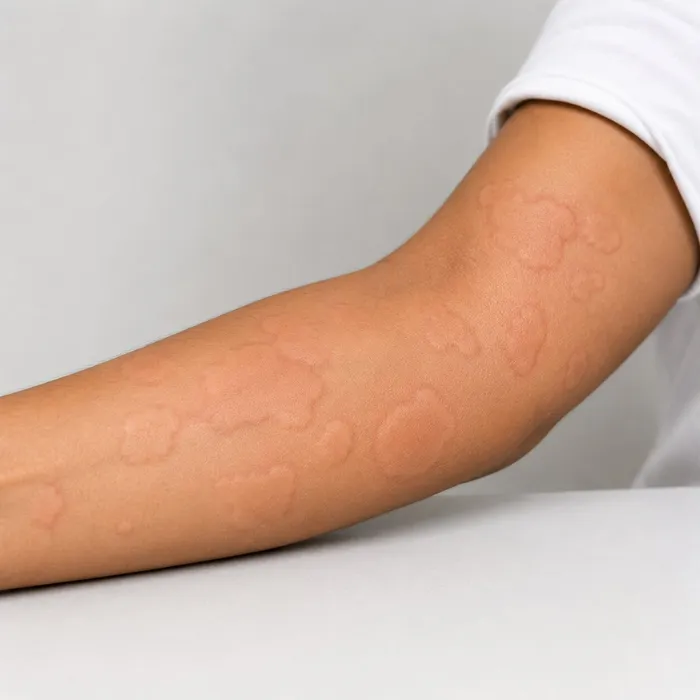
Sudden onset of raised, itchy welts?
A single episode of hives, especially with an identifiable trigger, often resolves on its own or with simple treatment. An evaluation helps confirm this and identify the likely cause.
Hives recurring for six weeks or more?
Urticaria lasting beyond six weeks is classified as chronic and typically needs a more structured evaluation and management approach than a one-off reaction.
Urticaria, commonly known as hives, presents as raised, itchy welts that can appear suddenly and, characteristically, move around and resolve within 24 hours at any given spot even as new ones appear elsewhere. It’s classified as acute (lasting under six weeks, often linked to an infection, food, or medication) or chronic (lasting six weeks or more, frequently without an identifiable external trigger) — and this distinction meaningfully changes the evaluation and treatment approach.
Acute urticaria is common and often resolves either on its own or with straightforward antihistamine treatment, particularly when a trigger like a recent infection or new medication is identified and addressed. Chronic urticaria is a different picture — often without a clear external cause, sometimes linked to underlying autoimmune activity, and generally requiring a more structured, sustained management approach.
What to Expect at Your Visit
Where possible, we examine the skin during an active episode, since the appearance and pattern of the welts helps confirm the diagnosis. We take a detailed history covering how long you’ve had symptoms, any new foods, medications, or infections around the time it started, and whether physical factors (pressure, cold, heat, exercise) seem to trigger episodes — all of which help distinguish acute from chronic urticaria and point toward likely causes.
Treatment Approach
Antihistamines are the first-line treatment for both acute and chronic urticaria, and chronic cases in particular often require doses higher than the standard over-the-counter recommendation to achieve adequate control — something we manage carefully rather than leaving patients under-treated on standard doses that aren’t working.
Where a specific trigger is identified, practical guidance on avoidance reduces the frequency of recurrence. For chronic urticaria that isn’t adequately controlled on antihistamines alone, additional treatment options are considered and coordinated based on how significantly it’s affecting your daily life.
Setting Realistic Expectations
Acute urticaria typically resolves within days to a few weeks. Chronic urticaria is more variable — some patients see it resolve within months, others manage it as a longer-term, fluctuating condition — and we discuss this range honestly rather than promising a fixed timeline, since chronic urticaria’s course is genuinely less predictable than acute cases.
How We Evaluate
- Skin examination during an active episode where possible
- History of onset, duration, and possible triggers (food, medication, infection, physical factors)
- Distinguishing acute from chronic urticaria based on duration
Treatment Options
- Antihistamine Therapy: First-line treatment for both acute and chronic urticaria, often requiring higher-than-standard dosing under medical guidance for adequate control.
- Trigger Avoidance Counselling: For urticaria with an identifiable trigger, practical guidance on avoidance to reduce recurrence.
- Escalated Therapy for Chronic Cases: For chronic urticaria not controlled with antihistamines alone, additional treatment options considered and coordinated based on severity.
Frequently Asked Questions
What causes urticaria (hives)?
What's the difference between acute and chronic urticaria?
Is urticaria always caused by a food allergy?
Book Your Appointment
Select an available time slot below to secure your consultation.
Patient Details
Already booked? Manage my appointmentWho is this appointment for?
Enter the patient's name below and your own WhatsApp number — the code and confirmation come to you.
Patients on this number — tap to fill in
Select Slot
Select a doctor and date to see available times.