Female Hair Loss: Diagnosis & Treatment
Hair loss in women often has different underlying causes than in men -- a thorough, hormone-aware evaluation is the starting point for effective treatment.
Book a Female Hair Loss ConsultationConsultation first · Treatment only when indicated
Noticing more hair in your brush or drain?
Increased shedding in women is common and often temporary -- linked to stress, postpartum changes, or diet -- but it can also signal an underlying condition worth identifying early. An evaluation clarifies which it is.
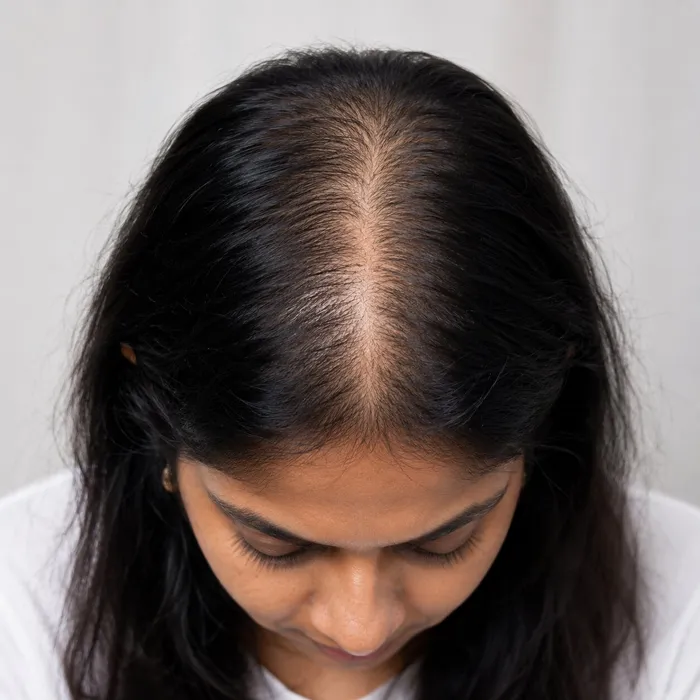
Dealing with visible thinning or a widening part?
Female pattern hair loss and other causes of diffuse thinning are very treatable when addressed early. We'll assess your pattern of loss and build a plan matched to the underlying cause.
Hair loss in women frequently differs from male pattern hair loss in both presentation and underlying cause. Rather than the receding hairline and crown thinning typical in men, female hair loss more often shows up as diffuse thinning across the scalp or a gradually widening centre part, and it’s commonly linked to hormonal shifts, nutritional deficiencies, thyroid dysfunction, PCOS, postpartum changes, or significant physical or emotional stress.
Because the possible causes are broader and more varied than in male pattern hair loss, a careful evaluation matters even more here — treating suspected pattern hair loss when the real driver is a thyroid or iron issue means the actual problem goes unaddressed.
What to Expect at Your Visit
Your first visit includes a scalp examination, a hair pull test, and a detailed history covering the timeline of your hair loss, menstrual and reproductive history, recent pregnancy or postpartum status, diet, and any symptoms suggestive of a hormonal or thyroid condition. Depending on what this history suggests, we may recommend blood investigations — including thyroid function, iron studies, and hormonal panels where PCOS or another endocrine cause is suspected.
This step is what allows treatment to target the actual cause rather than treating hair loss generically.
Treatment Approach
Where an underlying hormonal, thyroid, or nutritional cause is identified, correcting it is often the most impactful step, sometimes in coordination with your gynaecologist or endocrinologist. For female pattern hair loss without an identifiable secondary cause, evidence-based topical therapy remains the foundation of treatment.
Treatment response is reviewed at follow-up, and the regimen adjusted if progress is slower than expected — consistency with topical treatment over several months matters more than any single addition to the regimen.
Postpartum and Stress-Related Shedding
A significant amount of hair shedding after childbirth (postpartum telogen effluvium) or following major physical or emotional stress is a normal, self-limiting process that typically improves within several months without specific treatment, though it can feel alarming while it’s happening. Part of the evaluation is distinguishing this temporary, self-resolving shedding from a progressive pattern that benefits from active treatment — so you’re neither left untreated when you need care, nor treated unnecessarily for something that will resolve on its own.
How We Evaluate
- Scalp examination and hair pull test
- Pattern assessment (diffuse thinning vs. patterned loss)
- Hormonal and nutritional blood investigations where indicated
Treatment Options
- Topical & Oral Medical Therapy: Treatment tailored to the underlying cause -- pattern hair loss, hormonal imbalance, or nutritional deficiency each require a different approach.
- Scalp-Directed Medical Therapy: Targeted topical treatment to support existing thinning hair, often combined with correcting an underlying hormonal or nutritional cause.
- Underlying Cause Management: Coordination with the appropriate treatment where thyroid dysfunction, PCOS, iron deficiency, or postpartum changes are identified as contributing factors.
Conditions We Manage
Frequently Asked Questions
Why is hair loss in women different from male pattern hair loss?
Is postpartum hair loss normal?
Can PCOS cause hair loss?
What are the treatment options for female hair loss?
Book Your Appointment
Select an available time slot below to secure your consultation.
Patient Details
Already booked? Manage my appointmentWho is this appointment for?
Enter the patient's name below and your own WhatsApp number — the code and confirmation come to you.
Patients on this number — tap to fill in
Select Slot
Select a doctor and date to see available times.