Acne Scar Treatment
The right treatment depends entirely on your scar type -- an accurate evaluation comes before any procedure.
Book an Acne Scar EvaluationConsultation first · Treatment only when indicated
Still getting active breakouts?
Scar treatment works best once active acne is under control -- treating scars while acne is still active risks new scarring during the same period. We'll assess whether your acne needs to be stabilized first.
Acne is controlled, scars remain?
Once active breakouts are under control, we can properly evaluate your scar type and discuss which treatments are likely to help and by how much.
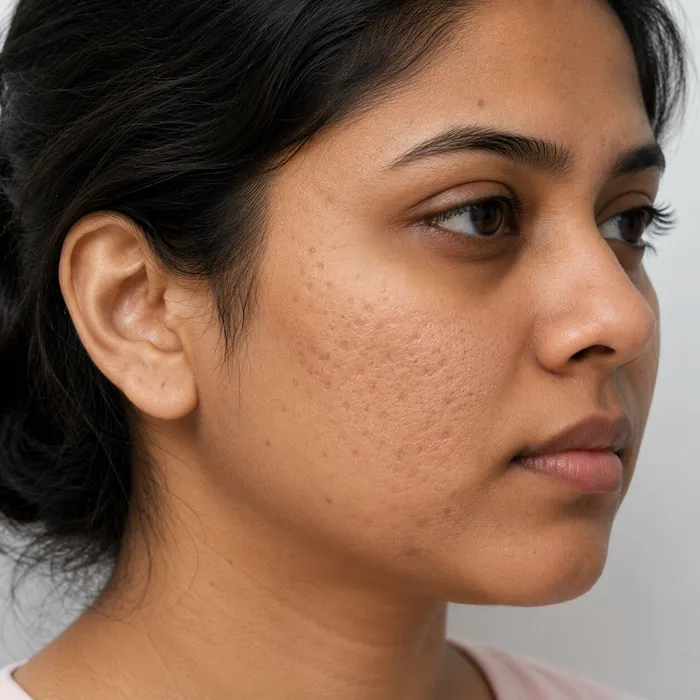
Acne scarring comes in several distinct patterns — icepick scars (narrow and deep), boxcar scars (broad with defined edges), and rolling scars (broad with sloping edges) — and each responds differently to the treatments available. A treatment that improves rolling scars well may do very little for icepick scars, which is why an accurate diagnosis of scar type matters more here than almost anywhere else in dermatology.
We’re upfront about what’s realistically achievable: acne scar treatments improve the appearance and texture of scarring — often meaningfully — but complete removal is not a realistic claim for established scarring, and we won’t tell you otherwise to sell a procedure.
What to Expect at Your Visit
We’ll examine your scarring closely to classify the types present, since most people have a mixture rather than one uniform pattern, and discuss which treatments are most likely to help your specific combination. We’ll also confirm that your active acne is adequately controlled, since starting scar treatment while acne is still flaring risks creating new scars during the same treatment period.
Treatment Approach
Chemical peels work well for superficial scarring and overall texture improvement, typically requiring a course of sessions spaced several weeks apart. Microneedling stimulates the skin’s own collagen production and is particularly useful for rolling and boxcar scars. For more pronounced or mixed scarring, a combination of procedures over an extended treatment course tends to produce better results than relying on one technique alone.
Setting Realistic Expectations
Most patients see meaningful, visible improvement in scar texture and appearance over a course of treatment — but scar treatment is a gradual process measured in months, not a single dramatic procedure, and different scar types have different ceilings on how much improvement to expect. We discuss this honestly at your evaluation so you can decide whether to proceed with clear expectations.
How We Evaluate
- Scar type and depth assessment (icepick, boxcar, rolling)
- Skin type and pigmentation assessment for procedure suitability
- Confirmation that active acne is adequately controlled before starting scar treatment
Treatment Options
- Chemical Peels: Layered peels to improve skin texture and superficial scarring over a course of sessions.
- Microneedling: Controlled micro-injury to stimulate the skin's own collagen response, used for rolling and boxcar scars.
- Combination Procedures: Scar-type-specific combinations of procedures, planned around your particular pattern of scarring rather than a single generic protocol.
Frequently Asked Questions
Can acne scars be completely removed?
How many sessions are needed to treat acne scars?
What's the best treatment for my acne scars?
Book Your Appointment
Select an available time slot below to secure your consultation.
Patient Details
Already booked? Manage my appointmentWho is this appointment for?
Enter the patient's name below and your own WhatsApp number — the code and confirmation come to you.
Patients on this number — tap to fill in
Select Slot
Select a doctor and date to see available times.