Advanced FUE Hair Transplant
Natural, permanent hair restoration through Follicular Unit Extraction, performed by a dedicated hair transplant surgeon.
Book Your Hair Transplant ConsultationConsultation first · Treatment only when indicated
Wondering if you're a candidate?
Not everyone with hair loss is a good candidate for transplantation -- donor area density, the pattern and stage of hair loss, and age all matter. An evaluation tells you honestly whether surgery makes sense for you right now, or whether medical treatment should come first.
Already decided on a transplant?
If you've done your research and are ready to proceed, we'll walk you through graft estimation, the FUE procedure itself, and what recovery and results actually look like -- without overselling graft counts you don't need.
Hair transplantation moves your own hair follicles from an area with stable, permanent growth (usually the back and sides of the scalp) to areas of thinning or baldness. Because the transplanted follicles carry the same genetic resistance to hair loss as the donor area, the results are permanent — the transplanted hair does not fall out the way the surrounding native hair might, over time.
Not everyone with hair loss needs — or benefits from — a transplant immediately. Some patients are better served by medical treatment first to stabilize ongoing loss before adding surgical density; others have enough donor supply and stable enough loss to proceed directly. This is a decision made together after a proper evaluation, not a default recommendation.
What to Expect at Your Visit
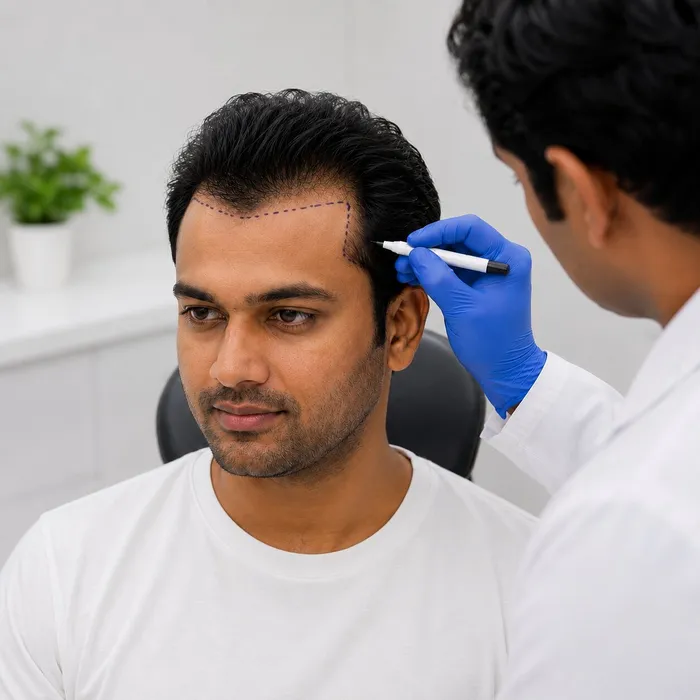
Your first visit focuses on understanding your pattern of hair loss, how it’s likely to progress, and whether your donor area has enough density to support a meaningful, natural-looking result — both now and years from now as native hair loss potentially continues elsewhere on the scalp. This includes a scalp examination, a discussion of your hair loss history and family pattern, and an honest graft estimate.
If you’re a good candidate, we’ll discuss hairline design, expected graft count, and a realistic timeline for results. If you’re not an ideal candidate yet — because loss is still active and unstable, or donor density is limited — we’ll explain why, and what would need to change for surgery to make sense.
The FUE Procedure Itself
Follicular Unit Extraction avoids the linear scar associated with older strip-harvesting techniques. Individual follicular units are extracted one at a time from the donor area using a fine punch instrument, then implanted into the recipient area following the hairline design agreed on beforehand.
The procedure is performed under local anaesthesia and typically takes several hours depending on graft count, with most patients going home the same day. Because extraction leaves only tiny, dot-like marks rather than a linear scar, FUE allows for shorter haircuts in the donor area without visible scarring — a meaningful consideration for many patients.
Graft Planning and Hairline Design
Graft count and hairline placement are planned around your donor supply, not around a number that sounds impressive. Overharvesting the donor area to chase a higher graft count can permanently reduce future donor supply — important if hair loss continues to progress after the transplant and a second session is ever needed.
Hairline design accounts for your face shape, age, and how your hair loss is likely to progress, so the result continues to look natural as you age rather than looking artificial or “too perfect” immediately after healing.
Recovery and Results
Transplanted grafts typically shed within the first few weeks after surgery — this is expected and normal, not a sign of failure. New growth from the transplanted follicles usually begins around three to four months post-procedure, with visible density improving steadily over the following months. Final results are typically assessed at twelve to fourteen months, once growth has fully matured.
Most patients return to non-strenuous activity within a few days and can resume exercise within a couple of weeks, following specific post-operative care instructions to protect graft survival during the critical early healing period.
How We Evaluate
- Donor area density and scalp laxity assessment
- Pattern and stage of hair loss evaluation (Norwood/Ludwig scale)
- Graft requirement estimation
Treatment Options
- Follicular Unit Extraction (FUE): Individual hair follicles are extracted one at a time from the donor area and implanted into thinning or bald areas -- no linear scar, minimal downtime.
- Graft Planning & Hairline Design: Hairline design is planned around your face shape and donor supply to look natural at every stage of future hair loss, not just immediately post-op.
- Post-Transplant Medical Therapy: Adjunct treatment to protect existing native hair and support graft survival, planned alongside the surgical procedure.
Conditions We Manage
Frequently Asked Questions
How many grafts will I need for a hair transplant?
Is there a limit to how many grafts can be taken from the donor area?
When will I see results after a hair transplant?
Is a hair transplant permanent?
Is the procedure painful, and what's the recovery like?
Will the hair transplant leave a visible scar?
Is there a minimum age for a hair transplant?
Book Your Appointment
Select an available time slot below to secure your consultation.
Patient Details
Already booked? Manage my appointmentWho is this appointment for?
Enter the patient's name below and your own WhatsApp number — the code and confirmation come to you.
Patients on this number — tap to fill in
Select Slot
Select a doctor and date to see available times.