
Scarring (Cicatricial) Alopecia
Some hair loss destroys the follicle itself. Early diagnosis protects the hair you still have.
Book a Hair Loss EvaluationPatchy hair loss with redness, scaling, or soreness?
Inflammation around follicles can signal a scarring process. Early evaluation matters.
Smooth, shiny areas where hair has gone?
This can indicate established scarring, and a doctor should examine it before any transplant is considered.
What Is It?
Most hair loss is non-scarring, meaning the hair follicle is preserved and can, in principle, grow hair again. In scarring alopecia, also called cicatricial alopecia, inflammation damages and destroys the follicle and replaces it with scar tissue. Once a follicle is destroyed, it cannot regrow hair. This is why early diagnosis matters so much: the aim is to stop the process while healthy follicles remain.
What Happens in the Scalp
In scarring alopecia, the immune system or other inflammatory processes target the area around the hair follicle, particularly the part that holds stem cells essential for regrowth. Over time, the follicle is replaced by scar tissue, and the scalp surface becomes smooth, often shiny, with no visible follicle openings. Because the damage is permanent, treatment focuses on halting progression rather than restoring lost hair.
Types of Scarring Alopecia
Several conditions cause scarring hair loss, and they behave differently.
Lichen planopilaris causes redness and scaling around follicles, with itching, burning, or tenderness, and patchy or diffuse hair loss.
Frontal fibrosing alopecia causes a slowly receding frontal hairline, often with loss of eyebrows, and mainly affects postmenopausal women, though it can occur in others.
Discoid lupus of the scalp produces scaly, scarred, sometimes pigment-changed patches, and may be associated with lupus.
Folliculitis decalvans causes painful, pus-filled bumps and crusting with scarring hair loss.
Central centrifugal cicatricial alopecia typically begins at the crown and spreads outward, and is seen especially in people with tightly coiled hair.
Other types exist, including those caused by injury, burns, radiation, or certain infections.
Symptoms to Watch For
Redness, scaling, or crusting around hair follicles, itching, burning, or tenderness of the scalp, pus-filled bumps, and patches of hair loss where the scalp looks smooth and shiny with no visible follicle openings. Not everyone has symptoms, and some people notice only gradually thinning hair. Hair loss may be patchy, or it may progress slowly in a way that mimics pattern hair loss.
Why It Is Often Missed
Scarring alopecia can resemble more common causes of hair loss, particularly in the early stages, and may be mistaken for pattern hair loss, dandruff, or alopecia areata. Because the damage is permanent, delay in diagnosis can mean losing hair that might have been saved. Anyone with persistent scalp symptoms or hair loss accompanied by inflammation should have an examination.
How We Diagnose It
Examination. We look at the scalp closely, checking for redness, scaling, crusting, and the presence or absence of follicle openings.
Dermoscopy. A handheld magnifying device reveals features of the follicles and scalp surface that are not visible to the naked eye, and helps distinguish scarring from non-scarring causes.
Biopsy. A small sample of scalp skin, taken under local anaesthetic, is examined under a microscope. It confirms the diagnosis and identifies the type, which guides treatment. A biopsy is often recommended, since the diagnosis changes management.
Other tests. Blood tests may be done to check for associated conditions, and swabs if infection is suspected.
Treatment
The aim is to control inflammation and stop progression. Treatment depends on the type and activity of the disease, and options include anti-inflammatory medicines applied to the scalp or injected, oral anti-inflammatory or immune-modulating medicines, and, where infection is involved, antimicrobial treatment. Treatment is often needed for months to years, with regular review. Because hair that has already been lost will not return, early treatment protects what remains.
Why This Matters for Hair Transplant
Hair transplantation is not suitable for active scarring alopecia. If the inflammatory process is still going, it can destroy transplanted follicles as well, and surgery can even provoke new activity. A transplant may be considered only after the diagnosis is secure, and after the disease has been quiet for a prolonged period under treatment, and even then results are less predictable than in pattern hair loss. In some types, surgery is not recommended at all.
This is why we always confirm the cause of hair loss before recommending a transplant (see who is a good candidate), and why a patient with unexplained scalp symptoms should not proceed to surgery without a proper diagnosis.
Living With the Condition
Hair loss from scarring alopecia can be distressing, especially when it affects the hairline or appears in visible areas. Camouflage options such as hair fibres or well-chosen hairstyles, and emotional support, are legitimate parts of care. We discuss realistic goals and monitor progress with photographs.
When to Seek Help
Seek an evaluation if you have hair loss with redness, scaling, burning, or tenderness, patches where the scalp looks smooth and shiny, a receding hairline with loss of eyebrows, or hair loss that does not fit the usual pattern. The sooner the diagnosis is made, the more hair we can protect.
Risk Factors
- Underlying inflammatory scalp conditions
- Autoimmune tendency
- Certain infections or injuries to the scalp
Symptoms
- Redness, scaling, burning, or tenderness of the scalp
- Loss of visible follicle openings
- Patches that slowly enlarge
Treatment
Examination and Dermoscopy
Looking closely at follicle openings and scalp surface.
Biopsy
A small scalp sample where the diagnosis needs confirming.
Anti-inflammatory Therapy
Aimed at halting progression, since lost follicles cannot be regenerated.
Related Conditions
Our Specialists



Visit Our Clinic
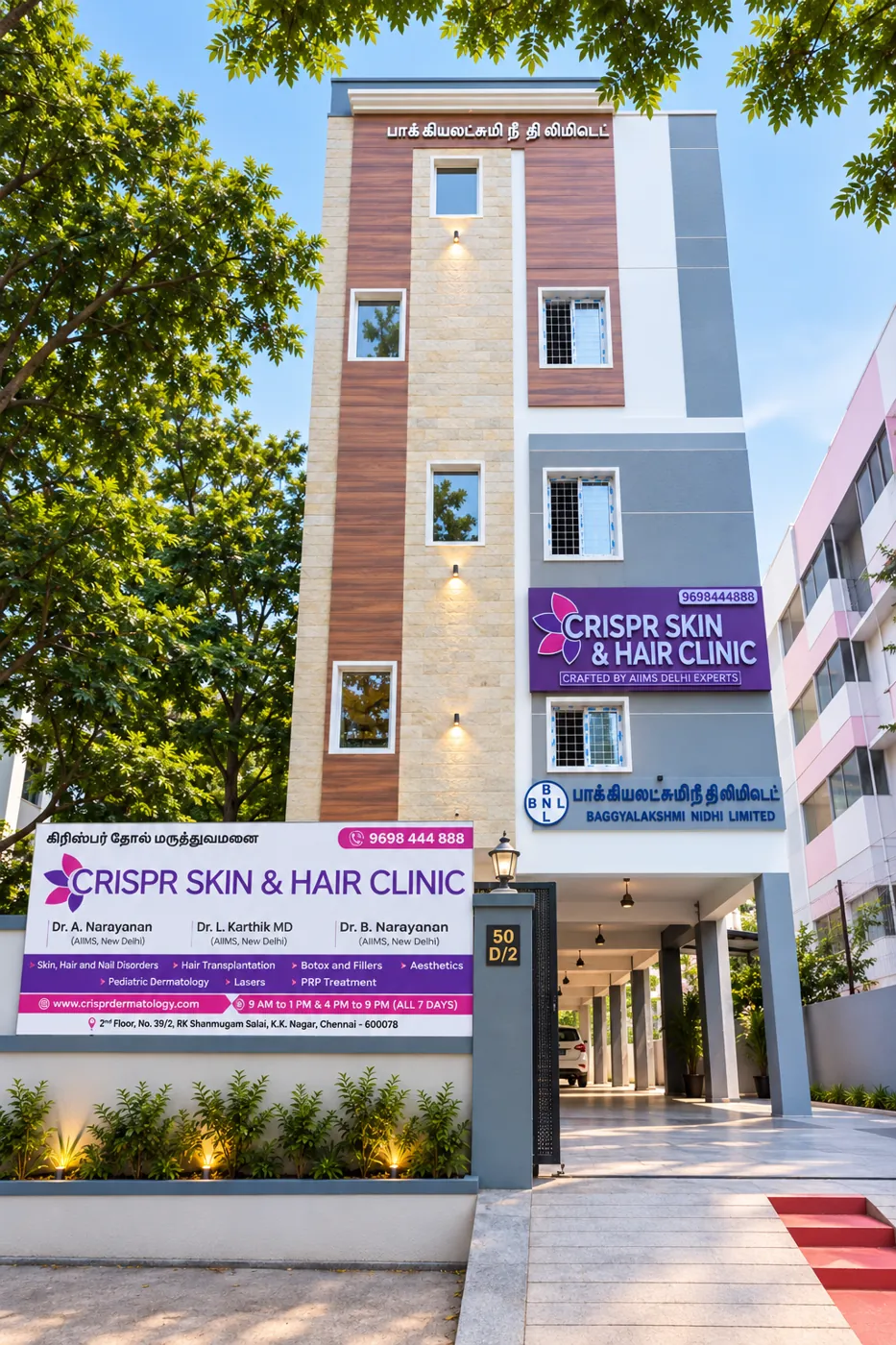
A look inside CRISPR Skin and Hair Clinic, KK Nagar.





Questions patients ask
Frequently Asked Questions
When should I see a doctor about hair loss?
What causes hair loss?
Is there a minimum age for a hair transplant?
Book a Hair Loss Evaluation
Schedule a comprehensive evaluation at CRISPR Skin and Hair Clinic. Choose your preferred time and secure your slot instantly.
Open Booking Calendar